Intellectual Property Rights

Intellectual Property  refers to creation of minds such as inventions ; be it literary, artistic, designs, symbols,colors, names, etc.

Whereas Intellectual Property Rights are the legally recognised rights to such innovations. Under such a law, owners are granted exclusive rights over intangible assets.  Common Intellectual Property Rights are granted in the form of copy-rights, trade marks, patents.

The WTO ( World Trade Organisation) intends to supervise, liberalise and regulate international trade between participating countries by laying down its framework and dispute resolutions. The WTO replaced the GATT ( General Agreements on tariffs and trade)

TRIPS ( Trade-Related Aspects of Intellectual Property Rights)

The Agreement on TRIPS is an international legal agreement between all the member nations of the World Trade Organisation (WTO). It sets minimal regulations on the member nations of WHO in forms of intellectual Property regulation.

TRIMS (Trade-Related Investment Measures)

The Agreement on Trade-Related Investment Measures (TRIMs) are rules that apply to the domestic regulations a country applies to foreign investors, often as part of an industrial policy.

Post- Independence India

Even after the triumph of India achieving Independence, economic conditions prevailing were really poor. No virtual industries or capital were present to invest in. The agricultural or local unit output was insufficient. Politically India had improved but it was still internally socially divided. Hence, efforts were being made from the government to bring up industrial development consequently came up the Industrial Policy of India.

”Industrial policy is a document that sets the tone in implementing, promoting the regulatory roles of the government.” 

  1. Industrial Policy of 1948-  The first Industrial Policy created after independence. It put industries under centre and state government.
  2. Industrial Policy of 1956- Replaced the policy of 1948. The features of this policy were:
    • A new classification of Industries.
    • Schedule A- gave power to center ie. industries control under the central government
    • Schedule B- mix of Central, State
    • Labour welfare.
  3. Industrial Policy of 1969- MRTP (Monopolistic and Restrictive Trade Practices ) was introduced upon review of previous two policies. It regulated unfair means and examined for predominant power concentration.
  4. Industrial Policy of 1973-  The country opened up to international trade, and hence was a vital development for countries industries. FERA was introduced, and Center/state and private owners joined hands. FERA helped ease trade deficits.
  5.  Industrial Policy of 1977-  This policy was influenced by the socialistic views. It encouraged village industries and decentralized industrialization.
  6. Industrial Policy of 1980 – Government changed and congress came into power. no new policies were introduced
  7. Industrial Policy of 1985-86 – Liberalization and Privatization
  8. Industrial Policy of 1991- The Latest Policy introduced and followed up to date.
  • focused on industrial licensing
  • abolition of MRTP
  • Foreign investments

This policy is followed to-date

What can we do?

“Good design is good Business.” – Thomas Watson

What goes on in the inside, shows on the outside. Running a good business requires both, a better inside and out. Analyzing factors that impact these are easy with a tool called SWOT.

What is a SWOT analysis?

Imagine your business is running good, but you’re unaware of the oncoming risk. That’s where SWOT analysis comes into picture. SWOT, a mnemonic for  Strengths, Weakness, Opportunities, Threats. It in-tails both Internal as well as external factors. It is a framework for organizing and using data from information collected from a situation analysis.

Let’s Break it down

STRENGTH –

  • Characteristics that prove an advantage over others
  • Positive, tangible and intangible attributes that are internal to an organisation.
  • Aspects such as human/ financial resources, goodwill, products and services, feedback, brand loyalty.

WEAKNESS-

  • Characteristics that prove a disadvantage when compared to others
  • Factors that do not meet expected standards
  • Influences growth and detracts from attaining goals
  • However, controllable, minimized and eliminated.

OPPORTUNITIES-

  • External attractive factors
  • Chances for greater profits, existence and development
  • Should be carefully analysed and grasped

THREATS-

  • External factors beyond organisations control
  • Jeopardize profitability and goals of organisation
  • Multiply vulnerability
blank business composition computer
Photo by Pixabay on Pexels.com


Creating a Strong Base

First things first, What is a Business?

An organization or economic system where goods and services are exchanged for one another or for money. Businesses can be privately owned, not-for-profit or state-owned.

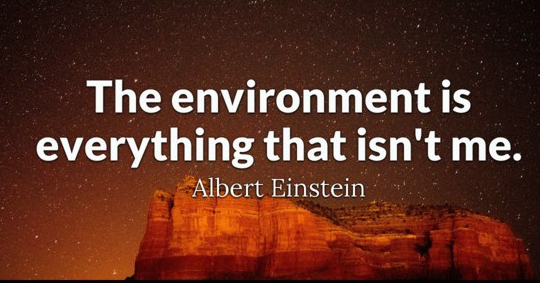
When asked in lower grades “What is an Environment?” , my reply was “anything that surrounds us.” Since then my perception of an environment has remained same. Hence, similarly a Business Environment, is all the internal and external factors that affects a Business Directly or Indirectly.
These factors aren’t very consistent they are dynamic and constantly changing. The changing needs, increasing necessities, and of-course technology, are all a part of the Business Environment.

“To survive in the market means to adapt to the changes as a fast as possible. To adapt to the changes means to be aware of the business environment.”

Disturbance or a Change in the environment may bring opportunities or even extreme threats. Business Environment done right, fosters growth and expansion.


What brings you here?

“The mind that opens to a new idea, never returns to its original size.” – Albert Einstein

 I personally second that statement. If you actually think about it, evidently,  a curious mind can reach Higher or even lower, depending on the direction he/she wishes to go in. Anyways!!! spreading positive vibes, here in my Blog I strive to talk about new ideas, technology, present scenarios, and business environment ( I might even drift to a topic that I’m passionate about or a topic you’ll take interest in).

Design a site like this with WordPress.com
Get started